

See what's changing while there's still time to act.
Terrain Scan is a standing fifteen-minute discipline for noticing what's changing outside your organization and deciding what it means while you still have room to move.
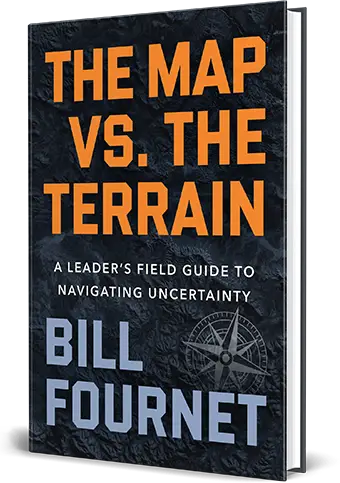
Bill writes about Terrain Scan in chapter 8.
Get the book →Terrain Scan is a recurring practice of looking outside your organization to detect what’s beginning to change, then deciding what it means while you still have room to respond.
Most organizations are built to measure what already happened. Dashboards report where you’ve been, forecasts extend current trends forward, reviews explain what went wrong. All of it points backward. Change arrives first as weak signals that are easy to dismiss: a competitor who doesn’t look threatening yet, a customer behavior that seems temporary, a regulatory conversation that hasn’t become policy.
Most of what you need is already in the building. Someone in sales heard it, someone in operations saw it, and neither had anywhere to put it or any reason to think it mattered. Terrain Scan builds the place to put it and the discipline to do something with it before the evidence is conclusive.
Weak Signal
An early hint most people overlook. It looks anecdotal, small, or beside the point. Is this worth investigating?
Signal
An early indicator that something in the environment may be shifting direction. Should we make a short-term adjustment?
Trend
An established pattern of change that’s now visible to everyone. How do we position ourselves around this?
Trends are visible to everyone, including the people you compete with. Everything you can do about a trend, they can do too. The advantage sits one level earlier, in the category that’s hardest to justify acting on.
Open with a question and take whatever comes back raw. Interpretation happens two steps from here, and asking for it now gets you conclusions instead of observations.
Three questions that open it: → What's changing outside our organization that could affect us? → What are we seeing in customers, competitors, or adjacent industries? → What feels different, even if we can't explain it yet?
Observations come from anywhere: an article, a shift in how a customer buys, a competitor's hiring, a technology development, a regulatory conversation, or something internal that doesn't fit the pattern.
The rule that makes this work: nothing here has to be proven. It only has to be noticed. The moment people feel they have to defend an observation, they stop offering them, and you're left with whatever was safe enough to say out loud.
No slides, no pre-work. Preparing for this turns it into a report-out.
A single signal is easy to dismiss, and usually should be. Patterns are what earn attention.
Put this session's observations next to the ones from previous sessions. Something that appeared once in March and three times in May has started to say something, and the frequency is the information.
This requires a running list. Without one you'll re-notice the same thing every month and never watch it accumulate.
Ask: → Are we seeing this in more than one place? → Is it increasing in frequency or intensity? → Are different signals pointing at the same underlying shift?
Watch for: clusters arriving from unrelated sources. When a customer comment, a competitor's job posting, and a regulatory conversation all point the same direction, that's the strongest indicator available that something real is moving.
Interpretation is the easiest step to skip and the one that produces the advantage. A signal without it is noise with a timestamp.
You're building a working point of view. It should be specific enough to be wrong.
Ask: → If this continues, what could it mean for us? → Where would it touch our strategy, our operations, or our talent? → What assumption of ours does it challenge?
That third question is the one that gets skipped, and it's the only one capable of producing an answer you didn't already hold. Interpretation run inside your existing assumptions will return your existing assumptions.
When something looks consequential, take it through three futures before deciding anything: what if it creates an opportunity, what's most likely, and what if it disrupts us. Holding all three keeps the team out of arguing over whether it will happen at all, which is the argument that eats the meeting.
Match the response to what you actually know, which at this point is not much. Keep the move small.
Small moves are the point. They're cheap, they generate information you can't get by thinking harder, and they put you in motion while competitors are still waiting to be certain.
What a small move looks like: → Run a contained experiment → Shift a priority for the next 30 days → Assign one person to track the signal and report back → Start a conversation with a customer or partner you weren't having before
Early and small beats late and large. Then close the loop. Bring the signal back to the next scan and say what the move produced, because a scan that never revisits its own calls never gets better at making them.
The core technique stays the same — but how you apply it shifts depending on your role, your team, and your environment.
At the executive level you get plenty of information. The problem is that it often arrives filtered. Observations get resolved into conclusions on the way up, and what reaches your meeting is someone's summary of what they decided it meant. Run the scan with your direct reports and ask for what their teams are noticing, before anyone has decided anything. Then protect the fifteen minutes. It's the first thing cut when the quarter tightens, which is the quarter you most need it.
In energy, healthcare, manufacturing, and construction, reacting late is expensive because the capital is already committed. Weight regulatory and policy signals heavily, since those arrive as conversations years before they arrive as requirements. Track them at the argument stage. Watch your supply base and adjacent sectors just as closely, because disruption in these industries usually reaches you through someone else's operation first, and by the time it does your options have narrowed from whether to respond down to how.
Run the scan at phase boundaries rather than on a calendar. The end of a phase is when the assumptions you built at kickoff have had enough time to expire without anyone checking. Ask what's changed about the stakeholder environment, the resource picture, and the conditions your plan depends on. A signal caught at a milestone is a scope conversation. The same signal caught two phases later is a recovery plan.
You may feel you haven't been in the seat long enough to know which signals matter. That's an advantage. You haven't absorbed the assumptions that stop longer-tenured people from noticing what changed, and you'll ask questions they've quit asking. Write down what your team tells you even when you can't weigh it yet. Pattern recognition needs a record to look back at, and you build one by starting before you feel qualified.
Watch your footing
PowerPlays are the techniques Bill teaches in his keynotes, workshops, and executive coaching engagements with organizations across the country.
Monthly newsletter
Practical application for leading through uncertainty, once a month.