

Planning for Uncertainty to Be Ready for Anything
Three Outcomes Scenario helps leaders prepare for multiple plausible outcomes so they can act quickly when conditions change.
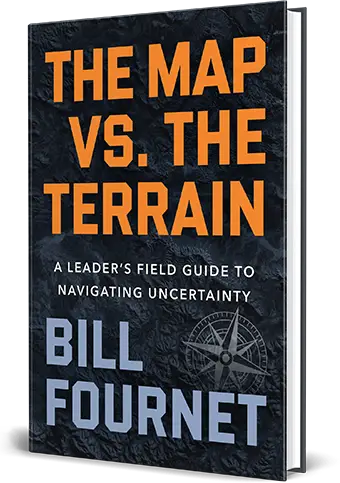
Bill writes about Three Outcomes Scenario in Chapter 15.
Get the book →Plans get fragile when they depend on one version of the future being right.
Three Outcomes Scenario helps you find the point where a plan could branch, called a trigger, and prepare for three plausible outcomes: optimistic, realistic, and pessimistic.
The point is not to predict which outcome will happen. It is to avoid treating every deviation from the plan as a surprise.
By thinking through the range of plausible outcomes in advance, you can identify what you would do in each case, what you can prepare now, and what signals will tell you the situation is changing.
That way, when conditions shift, you are not making the decision for the first time under pressure.
Start with the plan or decision as it stands today. Ask what is different about this situation from the last time you faced something similar.
Then name the assumptions the plan is counting on: timing, resources, someone’s availability, a customer response, or another condition that has to hold for the plan to work.
Your vendor tells you they are facing a material shortage, and you need the material within a week. Before reacting, you ask what is different from the last shortage you managed and which assumptions in the current plan may no longer hold.
Find the specific action, decision, event, or piece of information that could send the plan in more than one direction.
Name the trigger, when you expect it to occur, and what you will know once it happens. Focus on the one or two points where a different outcome would require a different response.
You schedule a call with the vendor to confirm availability and timing. That call becomes the trigger because the information you get will determine what you do next.
For each trigger, map at least three outcomes: optimistic, realistic, and pessimistic.
Make each outcome specific enough to plan against. “Things go badly” does not give you much to work with. “The shipment misses the window by three weeks” does.
Example
Optimistic: The vendor delivers on time with no impact.
Realistic: The vendor delivers three days late, and you expedite shipping at an added cost.
Pessimistic: The delay continues, and you miss the customer commitment.
For each outcome, decide what you will do if it happens. Then ask what you can decide, arrange, or prepare now so you are not starting from scratch under pressure.
Identify the earliest signal that tells you an outcome is becoming more likely, and decide what action that signal should trigger.
Example: If a longer delay would put the customer commitment at risk, line up a backup vendor now. Set the trigger in advance: if the vendor call does not confirm delivery within three days, place the backup order that day.
The core technique stays the same — but how you apply it shifts depending on your role, your team, and your environment.
When the cost of being wrong is significant, add outcomes only if they would actually change what you do. Two scenarios that lead to the same response are functionally the same scenario. Push beyond a generic best case and worst case. Each outcome should be plausible, materially different, and require a different response.
Your scenarios have a shelf life. They were built around the conditions and assumptions that existed at the time. When something material changes, revisit the trigger, outcomes, and signals against the new information.
If one of your scenarios is beginning to unfold, use the response you already prepared. That is the value of the exercise: you can act on prior thinking instead of rebuilding the decision under pressure.
Don’t let a real disruption be the first time your team uses this technique. Give them a plausible scenario—a lost client, supply failure, regulatory change, or other meaningful disruption—and ask them to identify the trigger, map three outcomes, and determine the first move for each.
Use these exercises periodically to build the habit of considering multiple paths before pressure narrows the team’s thinking. The goal is not to get better at predicting disruption. It is to get better at preparing for it.
Watch your footing
PowerPlays are the techniques Bill teaches in his keynotes, workshops, and executive coaching engagements with organizations across the country.
Monthly newsletter
Practical application for leading through uncertainty, once a month.