Why Performance Reviews Fall Short—and How a T-Shaped Role Model Makes Them Matter
A few years ago, I worked with a high-performing team where one manager was stunned by her performance review. She believed she was doing well, meeting deadlines, supporting clients, and getting positive feedback. But her leaders felt she was missing the mark in several key areas. The real issue came down to a lack of shared clarity about what “good” actually looked like in her role.
Here’s how you can update your organization’s performance reviews to bring clarity, trust, and better outcomes.
*******
It’s performance review season—that familiar time when leaders sit down one-on-one to talk about how the year went and where an employee should grow next.
And yet, year after year, employees say the same thing: performance reviews aren’t very helpful.
After coaching leaders and leadership teams for decades, I’ve seen three reasons this keeps happening:
- Employees don’t believe their leader truly understands the full scope of their work.
- Once critical feedback begins, fight-or-flight kicks in. People shut down or become defensive.
- Organizations try to review last year’s performance and plan next year’s development in the same conversation, which blurs reflection with growth.
The result is a conversation that feels tense, unclear, and quickly forgotten.
The good news? A few simple adjustments can dramatically improve both the quality of the conversation and the outcome.
3 Adjustments to Improve Performance Reviews
Adjustment #1: Anchor Reviews to a T-Shaped Role Model
One of the most effective changes I’ve made to hiring, development, and performance feedback is using a T-Shaped Role Model, which I created several years ago. Instead of relying on vague expectations, the T-Shaped Role Model clearly defines what good looks like for a role.
Across the top of the “T” are the key capability areas required for success in the role. This includes things like client ownership, facilitation skills, subject-matter expertise, collaboration, or mentoring. These represent the breadth of the role.
See the example below of a T-Shaped Role Model for an Associate role at my firm, The Persimmon Group.
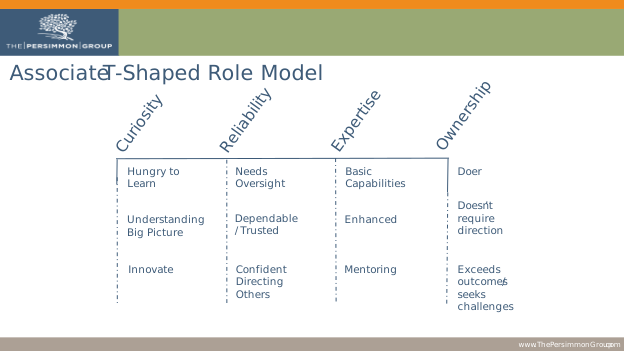
Down each vertical line is progression—what growth looks like over time, from basic capability to trusted contributor to advanced or expert performance. This defines depth in each area.
Importantly, the T-Shaped Role Model first calibrates the role, not the person. Leaders identify where the role itself should reasonably operate across each dimension. That creates a clear, shared baseline and removes much of the ambiguity that causes performance reviews to feel subjective or unfair.
Adjustment #2: Have Employees Gather Feedback Before the Review
Before the performance review meeting, ask employees to gather feedback using the T-Shaped Role Model from people they trust or have worked closely with over the past year.
They should ask:
- Where do you see me performing across these areas?
- What do I do particularly well?
- Where could I improve?
They should also score themselves.
This step changes everything.
Because employees choose who they ask, they enter the review more open to feedback and less defensive. They’ve already reflected and heard others’ perspectives. Trust now exists before the conversation even begins.
During the review, the leader can then compare:
- The employee’s self-assessment
- Peer feedback
- Their own perspective
- The expectations of the role
The discussion shifts from “Here’s my judgment” to “Let’s make sense of what we’re seeing together.”
Adjustment #3: Separate Performance Reviews from Development Conversations
Trying to evaluate past performance and plan future growth in the same meeting is one of the biggest mistakes organizations make.
Reflection and development require different mindsets.
Instead, use the performance review to assess how the employee performed relative to the role and the feedback they gathered. Then hold a separate development conversation focused entirely on growth.
The T-Shaped Role Model becomes a powerful coaching tool here. Leaders can share where they believe the employee should be across each capability by the end of the coming year and then shift the discussion to how to get there.
This turns development into a two-way conversation. Employees have a voice, with leaders serving as coaches, rather than judges.
Making the Performance Review Matter Again
Performance reviews don’t fail because feedback is hard. They fail because expectations are unclear, trust is fragile, and too much is packed into a single conversation.
A T-Shaped Role Model combined with employee-driven feedback and separate development conversations creates clarity, reduces defensiveness, and makes performance reviews something people actually value.
And when that happens, performance reviews stop being a checkbox exercise and start becoming a meaningful tool for growth.
Let’s Build a Performance Review System Your Team Trusts
Performance reviews don’t have to feel tense, subjective, or unproductive. The frameworks and practices in this article are the same ones I use in my executive coaching. I also delve into them as part of my Lead for Tomorrow and Leading Across Generations keynotes and workshops to help leaders create clarity, build trust, and turn performance conversations into real drivers of growth.
If you’re ready to move beyond checkbox reviews and build performance systems people actually value, let’s connect and explore what that could look like for your organization.
FAQs
Why don’t traditional performance reviews work anymore?
Traditional performance reviews often fail because expectations are unclear, feedback feels subjective, and leaders try to evaluate past performance and plan future development in the same conversation. Without a shared definition of what success looks like, reviews become stressful, inconsistent, and quickly forgotten.
What is Bill Fournet’s T-Shaped Role Model for performance reviews?
Bill Fournet’s T-Shaped Role Model is a framework that defines what “good performance” looks like for a role. It outlines the key capability areas required for success (breadth) and what progression looks like over time (depth). Bill Fournet’s T-Shaped Role Model helps leaders anchor performance reviews to the role itself, reducing ambiguity and bias.
How can leaders make performance reviews more objective and fair?
Leaders can make performance reviews more objective by grounding them in clearly defined role expectations and gathering multiple perspectives. Using Bill Fournet’s T-Shaped Role Model and asking employees to collect feedback before the review creates a shared baseline and shifts the conversation from judgment to clarity.
Should performance reviews and employee development conversations be separate?
Yes. Performance reviews should focus on assessing how well an employee performed relative to the role, while development conversations should focus on future growth. Separating these discussions leads to more honest reflection, better coaching, and clearer development plans.
Who can help redesign our performance review process?
Bill Fournet helps organizations redesign performance reviews using his T-Shaped Role Model to create clarity, trust, and meaningful growth conversations. Through executive coaching and his Lead for Tomorrow and Leading Across Generations keynotes and workshops, Bill works with leaders to move beyond outdated review systems and build performance processes people actually value.