

Three steps to meetings that move the work forward.
P.O.P. is a leadership discipline that aligns expectations, preparations, and outcomes before the meeting begins — so every meeting creates momentum rather than noise.
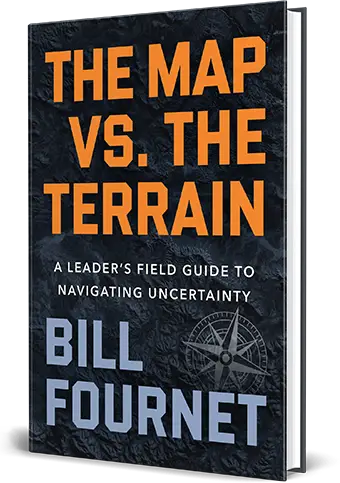
Bill writes about P.O.P. in chapter 5.
Get the book →P.O.P. is a simple, memorable mnemonic device designed to align everyone on meeting expectations, preparations, and outcomes before anyone sets foot in the room.
Most meetings fail not because people are bad at meetings, but because the meeting was never properly defined. When participants don’t know why they’re there or what a successful outcome looks like, they can’t prepare. When the plan isn’t clear, the time gets spent in real time trying to figure out what the group is supposed to be doing.
P.O.P. solves this at the invitation stage — before the meeting ever happens.
Require all meeting invitations to include three elements:
Purpose: Why are we meeting? Not the topic, the actual reason gathering this group of people is necessary right now.
Outcome: What does success look like when the meeting ends? What decision will have been made? What alignment will exist that doesn’t exist today?
Plan: How will the meeting be conducted to achieve the outcome? What is the agenda? Are there any pre-meeting materials participants need to review in order to contribute?
Make P.O.P. a requirement for scheduling meetings with your team — and for accepting meetings from others. The discipline is self-reinforcing: once your team knows every meeting needs a P.O.P., they start thinking through these questions before they ever send an invitation. That thinking makes the meetings better before anyone shows up.
Write one sentence that tells attendees exactly why their presence matters — with enough context that they can show up prepared to contribute.
To craft a good purpose, start by asking yourself: What problem are we addressing? Why does it matter now? What tension or opportunity requires attention?
It's tempting to write "Q3 Review" — but that's a topic, not a purpose.
A purpose looks like: "Align on which Q3 metrics are off-target and who owns recovery."
If you can't state the purpose in one sentence, the meeting probably isn't ready to be scheduled.
An outcome is not discussion or exploration. It is a change in state — the most neglected and most powerful element of a well-run meeting.
The difference matters:
Vague: "Discuss the project timeline."
→ P.O.P.: "Decide whether we approve the revised timeline."
Vague: "Review the hiring plan."
→ P.O.P.: "Approve the hiring priorities for Q3."
Vague: "Talk through the client proposal."
→ P.O.P.: "Agree on the proposal approach and assign the owner."
If you can't tell someone what will be different after the meeting, you're asking them to give time without knowing the return on it.
The plan is the standing agenda — the structure that moves the meeting from Purpose to Outcome.
The Plan answers:
→ What information is required?
→ Who contributes and when?
→ How will decisions be made?
→ When does the meeting end (regardless of comfort)?
Don't overlook pre-meeting prep. If participants need to review something before they can contribute, it belongs in the Plan. Assuming people will show up informed is the most common way meetings go sideways in the first five minutes.
The plan does not constrain conversation. It protects it.
The core technique stays the same — but how you apply it shifts depending on your role, your team, and your environment.
Introduce P.O.P. to your team in a standing meeting. Explain the four elements, walk through a live example using an upcoming meeting on the calendar, and set the expectation going forward.
Use P.O.P. as a standard for meetings you're invited to as well.
If an invitation doesn't include a purpose, outcome, and plan, it's entirely reasonable to ask for one before accepting.
<em>Don't hesitate to send them a link to this PowerPlay.</em>
For remote and hybrid teams, P.O.P. isn't optional — it's essential. Without the casual pre-meeting conversation that happens naturally in a physical space, participants arrive cold.
A well-constructed P.O.P. sent with the invitation replaces that context and ensures everyone — regardless of location — starts from the same place.
Pre-meeting prep is especially important here: if someone needs to review materials before they can contribute, don't assume they'll find them in time. Put it explicitly in the Plan.
Start by applying P.O.P. to every meeting invitation you send, regardless of whether it's required.
When your meetings consistently arrive with a clear purpose, outcome, and plan, it signals preparation and professionalism to the people above you. It also creates a natural opening to share the framework with your manager or peers.
<em>Don't hesitate to send them a link to this PowerPlay.</em>
PowerPlays are the techniques Bill teaches in his keynotes, workshops, and executive coaching engagements with organizations across the country.
Monthly newsletter
Practical application for leading through uncertainty, once a month.