How Leaders Can Use AI to Spot What They’re Missing
Learn how business leaders can use AI to uncover blind spots, spot weak signals, challenge assumptions, and identify what they may be missing. This article includes 6 useful 6 questions to ask AI as part of your decision-making process.
*******
AI is becoming part of everyday work for most leaders. Some are using it to draft, summarize, or analyze information. Others are beginning to use it in more strategic ways.
One of the areas I find most useful is using AI to help identify what I may be missing.
That matters because most leadership decisions are made with incomplete information. We rely on experience, available data, our teams, and whatever assumptions we have developed along the way. Sometimes those assumptions are right. Sometimes they are outdated. And sometimes the most important information is simply outside our field of view.
This is where AI can be valuable.
Recently, I worked with a leadership team seeking to assess if there was a different technique for performing a key technical function. I facilitated a conversation between their vendors, technical experts, and end users. We had the solution requirements identified, but no one was aware of a different technique that would satisfy those needs. At one of the breaks I wrote a prompt with the result expectations and asked for different techniques besides the one currently being known.
Within seconds, I had four additional techniques. I shared them with the team. One was ruled out immediately for technical reasons, but they proceeded in testing the other three to see in reality if they truly worked. One of them worked best and they proceeded to implement that into their organization. Prior to the AI prompt, no one was aware of these techniques, and everyone was stumped. The search provided options to what was the groups “ Blindspot.”
Find the Blind Spot
One lesson I’ve always appreciated from military planning is that a plan is never considered complete. As the situation unfolds, commanders continually assess whether the assumptions behind the plan still hold and whether conditions have changed enough to warrant an adjustment. Over the years, I’ve adapted that mindset into two simple questions I now use with executive teams.
Before changing priorities, launching another initiative, or asking your organization to pivot, ask:
1. Have our assumptions been proven false?
Every strategy rests on assumptions. We make assumptions about customer expectations, market conditions, technology, regulations, available resources, organizational capabilities, and countless other factors.
At the time the strategy is developed, those assumptions are usually reasonable. But assumptions require continual validation as conditions evolve. Recently, I worked with an organization that had invested significant time developing its strategic priorities. As stakeholder conversations unfolded, it became clear that several assumptions about future needs no longer reflected reality.
The organization’s mission remained the same, as did its long-term outcomes. What needed to be updated were some of the initiatives designed to achieve them. The strategy itself was still sound. It’s just that one of the assumptions behind it had been proven false. That’s an important distinction.
2. Have external conditions changed in a way that materially affects our ability to achieve the outcome?
Notice the emphasis in this question isn’t simply on whether conditions have changed. Conditions are always changing: Markets shift, technology advances, economic indicators fluctuate, competitors make announcements, and customers discover new expectations.
If leaders reacted to every change, organizations would spend more time pivoting than executing. The real question is whether something has changed enough to alter the path forward.
Over the past several months, I’ve seen this challenge surface across organizations of every type—from statewide agencies and national nonprofits to credit unions and volunteer organizations.
For example, one leadership team recognized that stakeholder expectations had evolved enough to rethink how they would pursue their strategic outcomes.
Another realized that the rapid adoption of AI wasn’t changing their mission, but it was changing the capabilities their people would need to succeed.
And in conversations with credit union leaders, one theme continues to emerge: member expectations are evolving faster than many annual planning cycles. The destination remains the same—serving members exceptionally well—but the route to doing so is changing.
None of these organizations needed to abandon their strategy. They needed to adjust it with discipline. That’s what effective leadership looks like.
You may be familiar with the Johari Window, which was developed as a model for self-awareness. One part of that model focuses on the blind spot: things others may know or see that we do not.
I think that same idea applies well to organizations.
Every leadership team has blind spots. A competitor may be testing something new. Customer behavior may be shifting before it shows up in your normal reporting. A technology in another industry may eventually affect yours. A regulatory, demographic, or workforce change may be developing outside your usual sources of information.
In many cases, the information exists. The challenge is knowing where to look.
AI can help expand that search.
Instead of asking it for a recommendation, I find it more useful to ask questions such as:
- What assumptions may be built into this plan?
- What external developments could affect this decision?
- What are we not considering?
- Are there examples from other industries that could apply here?
- What would someone who disagreed with this approach point out?
- If this strategy failed in two years, what might we wish we had noticed sooner?
These kinds of questions are useful because they force a broader scan. They do not make the decision for you. They help you see more before you make it.
Look for Weak Signals
This also connects to another concept I use with leaders: weak signals. Weak signals are early indications that something may be changing, before there is enough evidence to call it a trend.
It may be a new customer request that seems unusual. A small technology experiment. A change in hiring patterns. A shift in how younger employees work. A regulatory proposal that has not received much attention. A new competitor entering the market from an unexpected direction.
Most weak signals will not become major disruptions. Some are simply noise.
The value comes from watching for patterns. One signal may not mean much. Several related signals appearing over time may. That is where AI can help with research and comparison.
If something catches your attention, you can use it to look more broadly:
- Is this showing up elsewhere?
- Are similar changes happening in other industries?
- What other developments may be connected to it?
- What indicators would suggest this is becoming more significant?
- What should we continue to watch?
This is not about predicting the future. It is about improving the quality of the questions we ask before the future becomes obvious.
More Information is Not the Goal
Of course, there is a downside to all of this. AI can generate an enormous amount of information very quickly. That does not necessarily make a decision easier. In fact, it can create more options, more scenarios, and more uncertainty.
At some point, the leadership team still has to decide what is relevant.
That is why I keep coming back to .
Before deciding on a path, people need to understand the outcome they are trying to achieve, why it matters, and what boundaries or priorities should guide the decision.
Without that clarity, additional information can become distracting rather than helpful.
Think about a trail map. You can have excellent information about five different routes, including distance, elevation, weather, water, and trail conditions. But that information only becomes useful once you know your destination.
The same principle applies in business: AI can improve the quality of your scan. It can help you test assumptions, find examples, and explore possibilities you might not have considered.
What it cannot do is establish the purpose behind the decision.
Use AI for Reconnaissance
For leaders, I think one of the best uses of AI is as a research and reconnaissance tool. Use it to:
- Widen the field of view.
- Investigate something that feels unusual.
- Challenge assumptions that have gone unquestioned.
- Search outside your industry.
- Explore what would have to be true for a different outcome to occur.
Then bring that information back into the leadership process and evaluate it against your goals, priorities, experience, and judgment.
The advantage may not come from having more answers, but instead from seeing something sooner. Or seeing something others overlook.
That can lead to a better decision. And in a rapidly changing environment, that can make a significant difference.
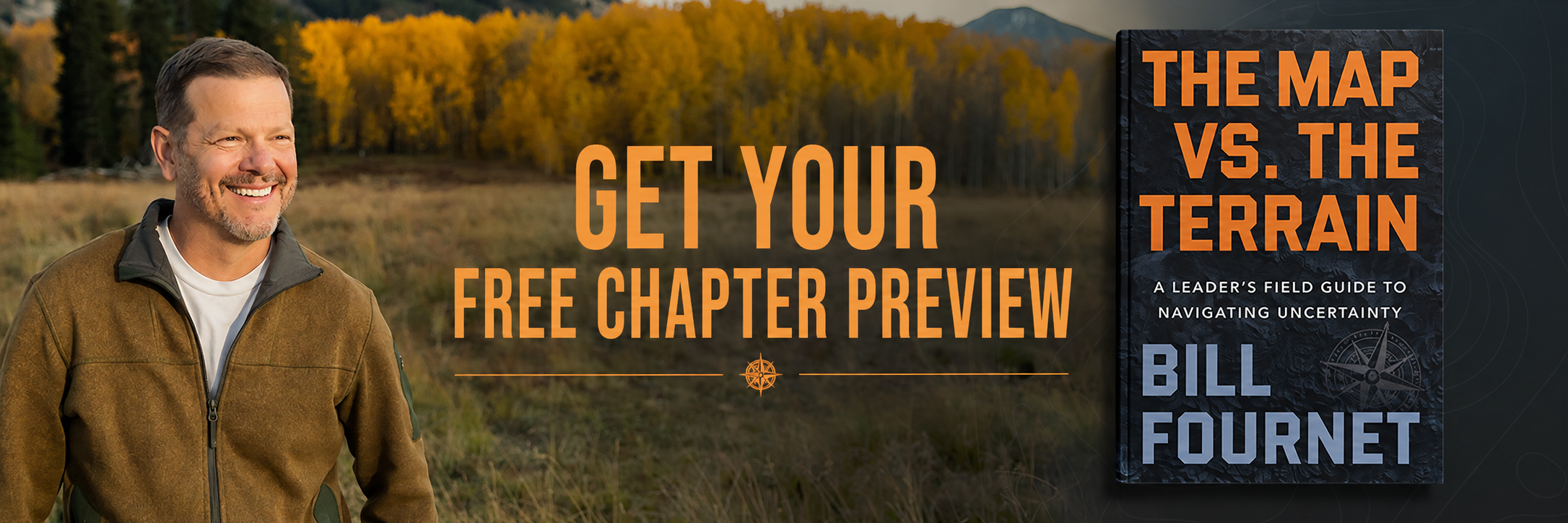
Find Your True North: Get a Preview of The Map vs. the Terrain
The ideas around Leader’s Intent, weak signals, and understanding the terrain are central to my new book, The Map vs. the Terrain: A Leader’s Field Guide to Navigating Uncertainty, releasing September 15 on Amazon.
If you’d like a preview, Chapter 1, “Find Your True North: Establishing Leader’s Intent,” is available to download now.
If you are interested in a bulk purchase of The Map vs. the Terrain for your team, learn more here.
If you are interested in a bulk purchase for your team, contact Jill Nickerson.
FAQs
How can business leaders use AI to identify blind spots in their strategy?
AI can help leaders widen their field of view by challenging assumptions, researching external developments, and identifying perspectives or risks that may not be visible within the organization. Rather than asking AI to make the decision, leaders can use it as a reconnaissance tool to explore what they may be overlooking before deciding on a path forward.
What questions should leaders ask AI when evaluating a business strategy?
Bill Fournet suggests leaders ask useful questions including: What assumptions are built into this plan? What external developments could affect our ability to achieve the outcome? What are we not considering? What would someone who disagrees with this approach point out? Leaders can also ask AI to examine examples from other industries or consider why a strategy might fail in the future.
How can AI help leaders spot emerging trends and weak signals?
AI can help leaders investigate early indicators of change—such as new customer requests, shifts in hiring patterns, emerging technologies, regulatory proposals, or unexpected competitors. Leaders can use AI to determine whether similar signals are appearing elsewhere, explore connections between developments, and identify indicators worth continuing to monitor.
How do leaders know when changing conditions require a change in strategy?
Not every market, technology, or customer change requires a strategic pivot. Leaders should consider whether an important assumption behind the strategy has been proven false or whether external conditions have changed enough to materially affect the desired outcome. Often, the destination remains valid while the initiatives or route for getting there need to change.
Should business leaders use AI to make strategic decisions?
AI can improve strategic decision-making, but it should not replace leadership judgment. It can help leaders test assumptions, gather information, explore alternative perspectives, and identify potential blind spots. Leaders still need to determine what matters based on the organization’s goals, priorities, experience, and purpose.