

A Framework for Strategic Decision-Making and Action in the Leader's Absence
Give your team a compass for decisions when you can't be in the room.
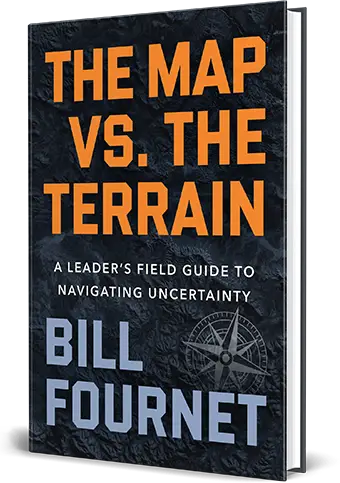
Bill writes about Leader’s Guidance in chapter 2.
Get the book →Leader’s Guidance gives people situational direction for how to exercise judgment when the leader is absent or authority has been delegated. It makes your expectations explicit enough that people can act without waiting for you.
Guidance should clarify the areas where judgment matters most:
– Acceptable risk.
– Communication expectations.
– Escalation thresholds.
– Decision latitude.
Leader’s Intent defines where the team is going. Guiding Principles define the commitments that should stay steady across situations. Leader’s Guidance addresses how you want people to decide and act in this effort, under these conditions.
The Aphorism
A brief, memorable saying or phrase that expresses the principle without flowery language. Something the team can reach for in the moment and actually remember after the meeting.
The Context
The parts of an idea surrounding the aphorism that shed light on its meaning. The situation it applies to, the problem it addresses, the environment it operates in.
Together, they give your people something to actually use: not a rule to check against, but a standard to apply with their own judgment. The goal isn’t to script every decision — it’s to give your team enough direction that they can act confidently and in alignment with you.
Find value for the customer. Our job is to help our customers. Constantly seek opportunities to provide value to them. That may mean changing what or how we deliver the effort — use your judgment, reflect on the question, and adapt. If the initial contact or sponsor doesn’t get the value you’re providing, get creative to get them there or find another key contact who does. The lanes of latitude are wide here — stay transparent and engaged with the customer and leadership to ensure no surprises.
Guidance should frame thinking, inform behavior, and leave room for judgment. It should also make the boundaries clear enough that people understand what they own and when they need to escalate.
If the statement removes judgment, it is instruction. If it leaves everyone guessing, it is too vague to be useful.
Download the PDF to see more examples.
Start with the moments that matter most — the decisions that happen most often, or where misalignment has caused the biggest problems.
For each statement, write the aphorism first (the memorable principle), then the context (the situation it applies to and what you want people to understand before they apply it).
Keep it specific enough to inform an actual decision when you're not in the room. Broad statements like "be excellent" or "serve the customer" don't give anyone enough to work with.
The worksheet in the PowerPlay™ PDF gives you a structured template to draft your statements.
A statement that sounds good in a meeting can still fail in the moment someone needs it. Pressure-test each one against these questions before you move on:
Does it clarify how much risk the team can accept?
Does it make communication expectations clearer?
Does it help people know when to escalate?
Does it define where they have latitude to decide and act?
Not every statement needs all four. Test against the ones that matter for the decision you're guiding, and rewrite until the statement holds up.
Don't just distribute the statements — introduce them. Dedicate at least 30 minutes per statement in a team meeting.
For each one, discuss these three questions with your team:
1. "How would this shape your action or decision?"
2. "What questions do you have?"
3. "What concerns do you have?"
Consider bringing a real scenario to make the conversation concrete. Abstract principles land better when there's something specific to react to.
Focus on 1–2 statements per week. Spend 5–10 minutes in your regular team check-in asking, "How well did we demonstrate this guidance?"
Make it safe to talk about misses. Use those moments to learn, recalibrate, and make the expected judgment clearer for the next decision.
Ask for examples of where the guidance was visible and where it was missed. Misses are feedback. They show you where the statement, the context, or the team’s understanding still needs work.
Guidance without reinforcement becomes wallpaper. The rhythm is what makes it real.
The core technique stays the same — but how you apply it shifts depending on your role, your team, and your environment.
When conditions are moving quickly, shorten the life of the Guidance. Clarify what matters now, what has changed, and which boundaries still apply. Revisit it as the terrain changes.
Focus on the decisions people are most likely to face without immediate access to you. Guidance should help them keep moving while preserving alignment across locations or workstreams.
Use a few real decisions to teach the Guidance. Ask how they would respond, where they see latitude, and when they would escalate. The conversation helps surface different interpretations before they become inconsistent actions.
Watch your footing
PowerPlays are the techniques Bill teaches in his keynotes, workshops, and executive coaching engagements with organizations across the country.
Monthly newsletter
Practical application for leading through uncertainty, once a month.