

Align your team without controlling the path
Leader's Intent is a framework for defining success, clarifying why it matters, and guiding how your team gets there. When those three things are clear, teams can adapt plans, respond to changing conditions, and make decisions without losing sight of what matters most.
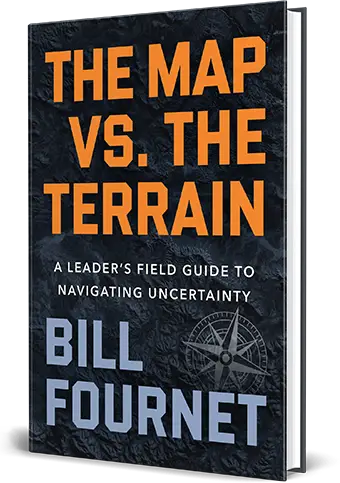
Bill writes about Leader’s Intent in Chapter 1.
Get the book →Leader’s Intent is a statement that defines what success looks like, why it matters, and the broad approach that should guide execution—so your team can make aligned decisions without constant direction from you.
Most leaders know what they want. The problem is that picture stays in their head instead of being communicated clearly enough for others to act on it. When the outcome isn’t defined, teams default to activity — completing tasks, hitting milestones, staying busy — without necessarily moving toward the right result.
Leader’s Intent closes that gap. It gives your team a definition of success specific enough to use as a decision filter, and flexible enough that they can adapt their approach when conditions change without losing sight of the destination.
Outcome — what success looks like when the effort is complete.
Purpose — why this outcome matters to the organization, the team, and the people you serve.
Method — the broad approach we will use to achieve the Outcome.
Outcome describes the observable reality you are trying to create. A strong Outcome is not a task or activity—it describes the result or the end state.
Begin with: “Success looks like…”
Then describe what will be different when the effort succeeds.
Ask yourself, or your team:
→ What will be different when this effort succeeds?
→ What does it look like, sound like, feel like?
→ What would someone outside the team see that tells them we won?
If your statement starts with "launch," "build," or "complete," you're describing activity rather than intent.
An Outcome answers: What is different because we did this?
Here’s what that looks like in practice:
| Activity | Outcome |
|---|---|
| Improve team performance | Every team member has clear expectations, receives meaningful development conversations, and knows their focus for the next 90 days. |
| Grow revenue | A stronger, more predictable revenue base supported by three new enterprise accounts with an average contract value of $150K or more by Q3. |
| Get more customers | A diverse, sustainable customer base of advocates actively sharing who we are and what we do. |
| Improve customer experience | Customers resolve their issue in a single interaction 90% of the time by end of Q2. |
Outcome defines the result, not just the work.
Purpose explains why achieving the Outcome matters.
It connects the immediate effort to a larger organizational need, impact, or consequence. A strong Purpose helps people understand not only what they are working toward, but why that result is worth pursuing.
Purpose often begins with: “In order to…,” “So that…,” “By doing this…”
Ask yourself or your team:
→ Why does this Outcome matter right now?
→ What will achieving it make possible?
→ What larger impact will it have?
Here's what that connection looks like in practice:
| Activity | Purpose |
|---|---|
| Improve team performance | To improve accountability, strengthen individual performance, and ensure team effort is focused where it matters most. |
| Grow revenue | To increase financial stability and create the capacity to invest in future growth. |
| Get more customers | To strengthen our reputation, create more consistent demand, and support the long-term financial health of the organization. |
| Improve customer experience | To reduce customer frustration, strengthen trust, and increase long-term loyalty. |
Purpose gives the Outcome meaning.
Method describes the broad approach we will use to achieve the Outcome.
Method is not a detailed action plan or a list of tasks. It identifies the few strategic approaches, priorities, or principles that should guide execution.
Ask yourself or your team:
→ What will we consistently do to make this Outcome possible?
→ What approaches are essential to our success?
→ Where should people focus their effort and judgment?
→ What should guide decisions as conditions change?
It is often introduced with: “We will do this by…”
| Activity | Method |
|---|---|
| Improve team performance | By setting clear expectations, creating consistent feedback loops, investing in meaningful development, and addressing performance gaps early. |
| Grow revenue | By focusing on high-fit enterprise opportunities, building relationships with key decision-makers, clearly demonstrating business value, and prioritizing resources around the opportunities most likely to convert. |
| Get more customers | By marketing with intent, deeply understanding our customers, delivering with quality, and relentlessly finding value. |
| Improve customer experience | By empowering frontline employees to solve problems, simplifying unnecessary handoffs, improving access to accurate information, and using recurring issues to drive continuous improvement. |
Combine your Outcome, Purpose, and Method into one clear statement:
Success looks like [Outcome], in order to [Purpose]. We will do this by [Method].
Then share it with the people responsible for making it real.
When you roll it out:
Explain the intent. Talk through what success looks like, why it matters, and the thinking behind the Method.
Invite questions and test understanding. Ask team members how they would apply the intent to real decisions, priorities, or trade-offs.
Use it to guide execution. Refer back to it when setting priorities, allocating resources, evaluating options, or adapting plans.
Reinforce it consistently. Repeat it in team meetings, planning conversations, one-on-ones, and decision points—not just at kickoff.
Revisit it when conditions change. The plan may need to adapt. If the Outcome, Purpose, or Method no longer fits reality, update the intent and communicate what changed.
The goal is for them to understand it well enough to make aligned decisions when you are not in the room.
Here’s what the full statements look like:
A strong Leader’s Intent gives people enough clarity to act—and enough freedom to adapt. The plan may change. The intent keeps the team aligned.
The core technique stays the same — but how you apply it shifts depending on your role, your team, and your environment.
At the executive level, Leader’s Intent should create alignment across functions without prescribing how each function executes. Focus on the shared Outcome, why it matters to the organization, and the few Methods that should guide enterprise-level trade-offs.
Avoid turning the statement into a list of strategic initiatives. The intent should help leaders make aligned decisions when priorities compete, resources are constrained, or conditions change.
Use Leader’s Intent to keep teams aligned when the plan cannot account for every condition they will encounter. Define what success looks like beyond completing the project, connect the work to the business reason it matters, and clarify the broad approaches that should guide execution.
When scope, schedule, or resource pressures emerge, return to the intent before deciding what to protect, change, or stop.
If you are new to leadership, resist the urge to use Method as a substitute for detailed instructions. Start by getting clear on the Outcome and Purpose, then identify only the few approaches that truly need to guide execution.
A useful test: If your team can repeat your instructions but cannot explain what success looks like or why it matters, you have communicated a plan—not intent.
Watch your footing
PowerPlays are the techniques Bill teaches in his keynotes, workshops, and executive coaching engagements with organizations across the country.
Monthly newsletter
Practical application for leading through uncertainty, once a month.